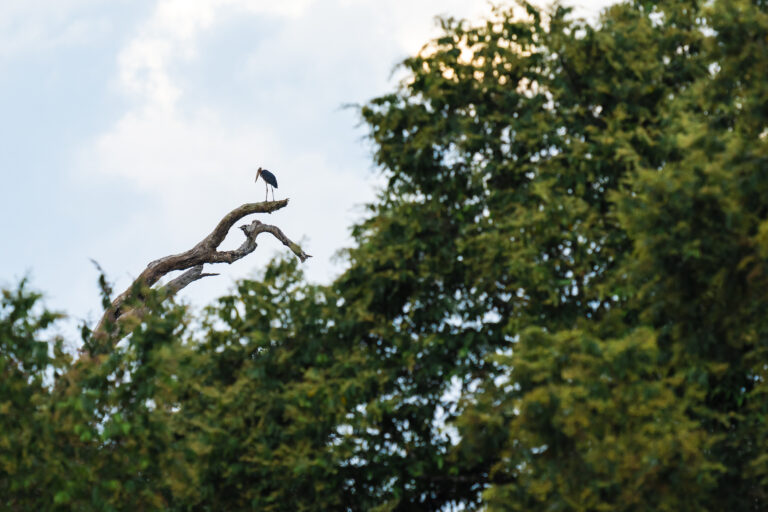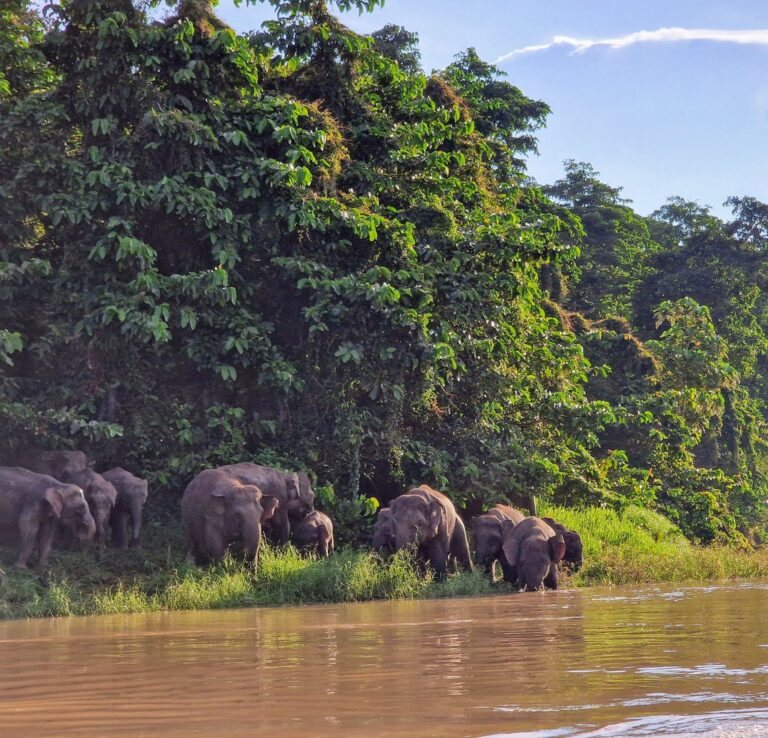
The forests along the Kinabatangan River are home to an extraordinary variety of wildlife, including orangutans, proboscis monkeys, pygmy elephants and eight species of hornbill.
But while the Kinabatangan remains one of Borneo’s most important wildlife areas, much of the surrounding forest has been altered by logging, agriculture and plantations. For some wildlife, this means losing food or shelter. For hornbills, there is another problem: finding somewhere suitable to nest.
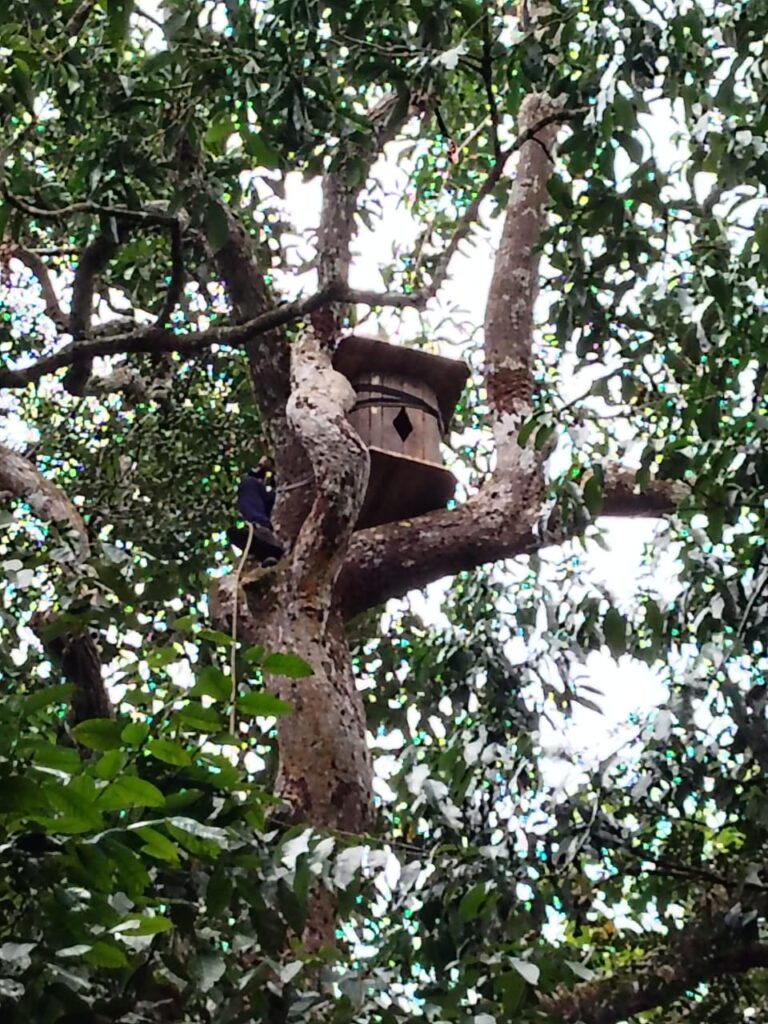
This is where nest boxes can help and this is why we have installed three at Hornbill Lodge.
What is a nest box?
A nest box is an artificial structure designed to provide wildlife with a safe place to breed when suitable natural nesting sites are scarce.
For hornbills, these are much larger and more specialised than the familiar bird boxes found in gardens. Hornbills nest inside cavities in large trees, but unlike woodpeckers, they cannot excavate their own nesting holes.
Suitable natural cavities can take decades, or even centuries, to develop. When large old trees are lost through logging, the number of suitable nesting sites can decline even if the surrounding forest subsequently regenerates.
This is an important issue in the Kinabatangan, where fragmented forest and a shortage of mature trees can limit opportunities for cavity-nesting hornbills.
Why are hornbill nesting sites so important?
Hornbills have a fascinating nesting strategy.
After the female enters a suitable tree cavity, she seals herself inside using mud and other materials, leaving only a small opening. The male then feeds her and, later, the chicks from outside.
Finding the right cavity is therefore critical. It needs to be large enough, secure from predators and weather, and suitable for raising young.
Hornbills are also important to the rainforest itself. Many species eat large quantities of fruit and disperse seeds as they move through the forest, helping plants regenerate and spreading seeds over considerable distances.
Protecting hornbills therefore helps protect the wider forest ecosystem.
How do artificial nest boxes work?
Conservation organisations working in the Kinabatangan have installed artificial cavities in suitable trees to provide an alternative to natural nesting sites.
Some of these structures have been designed using durable materials such as plastic drums, with modifications to create an environment suitable for hornbills. They are installed high in trees and monitored using camera traps to see which species visit and whether they successfully breed.
The approach has produced encouraging results.
Artificial cavities installed in the Kinabatangan have been used by several hornbill species, including Rhinoceros Hornbills, Wrinkled Hornbills, Bushy-crested Hornbills and Oriental Pied Hornbills. Rhinoceros Hornbills have successfully bred in artificial nest cavities, demonstrating that these structures can provide valuable breeding opportunities where natural cavities are scarce.
However, nest boxes are not a replacement for natural forest. Not every box will be used, and other animals may occupy them instead.
A temporary solution to a long-term problem
Perhaps the most important point is that nest boxes are a conservation tool, not a substitute for protecting forests.
Large old trees remain the best source of natural nesting cavities, and protecting existing forest is essential if hornbills are to thrive in the long term. But forests take many decades to mature, while wildlife needs suitable habitat today.
Artificial nest cavities can therefore act as a bridge — providing hornbills with somewhere to breed while the surrounding forest regenerates.
This is particularly valuable in the fragmented landscapes around the Kinabatangan, where conservation efforts combine forest protection, habitat restoration and wildlife monitoring.
Look beyond the nest box
The next time you see a hornbill flying along the Kinabatangan River, there is much more to the sighting than a spectacular bird. Its survival depends on healthy forest, abundant fruiting trees and, ultimately, somewhere safe to raise its young.
A nest box may seem like a simple solution, but it represents something much bigger: giving wildlife a helping hand while the forest recovers.
In the Kinabatangan, where conservation and tourism exist side by side, even a small intervention can play a role in keeping one of Borneo’s most remarkable ecosystems alive.