
Thirty acres of private riverfront forest, a working conservation programme, and a lodge run to leave the Kinabatangan better than we found it.
We are fortunate to be located in an area of outstanding natural biodiversity, and it is our responsibility to do our utmost to protect the landscape, wildlife and communities around us. Responsible tourism and sustainable business practices are the key to preserving this fragile area for generations to come.
That commitment runs through everything at Hornbill Lodge: the 30 acres of forest we own and manage on the riverbank, the way our guides work, the food on your plate and the engines on our boats.
We aim to make a difference to the people, wildlife and land surrounding us by providing alternative livelihoods, engaging in respectful wildlife encounters, and participating in habitat restoration initiatives.
Set on 30 acres in the heart of the Kinabatangan, Hornbill Lodge owns and manages one of the largest private riverfront conservation areas on the river. That is space for wildlife to feed, move and breed, and space for you to walk quietly among it.
Land on the Lower Kinabatangan is under constant pressure from plantation agriculture. Keeping 30 acres of it forested, and actively improving it, is the most useful thing we can do for the animals you have come to see. Our team works on that land all year round.
Conservation can mean creating space for wildlife in different ways. In 2025, we replanted a former football field with Napier and Berau grasses, providing an additional food source for Bornean pygmy elephants moving through the Kinabatangan landscape.
Maintaining this open habitat complements our wider efforts to protect and restore forest around the lodge. Elephant grass can help provide feeding opportunities for elephants while potentially reducing their need to enter nearby agricultural areas in search of food.
The project demonstrates that conservation isn't always about planting trees: maintaining a diverse mix of habitats can be equally important for supporting wildlife and healthy ecosystems.
Hornbill Lodge is helping address a shortage of natural nesting sites for hornbills along the Kinabatangan River by installing artificial nest boxes on its riverfront property.
Hornbills depend on large, mature trees with suitable cavities for breeding, but these nesting sites can be scarce in a landscape affected by logging and habitat loss. By providing alternative nesting cavities, we aim to give hornbills an additional opportunity to breed while the surrounding forest regenerates.
The boxes form part of our wider commitment to creating space for wildlife and supporting conservation. For Hornbill Lodge, small, practical initiatives like these can make a meaningful contribution to protecting Kinabatangan wildlife.
Minimising our environmental impact is mostly a matter of unglamorous daily habits. These are the ones we hold ourselves to, and they are all visible during your stay.
we collect and reuse rainwater for cleaning, gardening and maintenance, alongside our main supply from the Bilit village filtration plant
100% of kitchen scraps are composted for use in our gardens
bottled mineral water is not sold at the lodge, and guests refill at our water stations instead
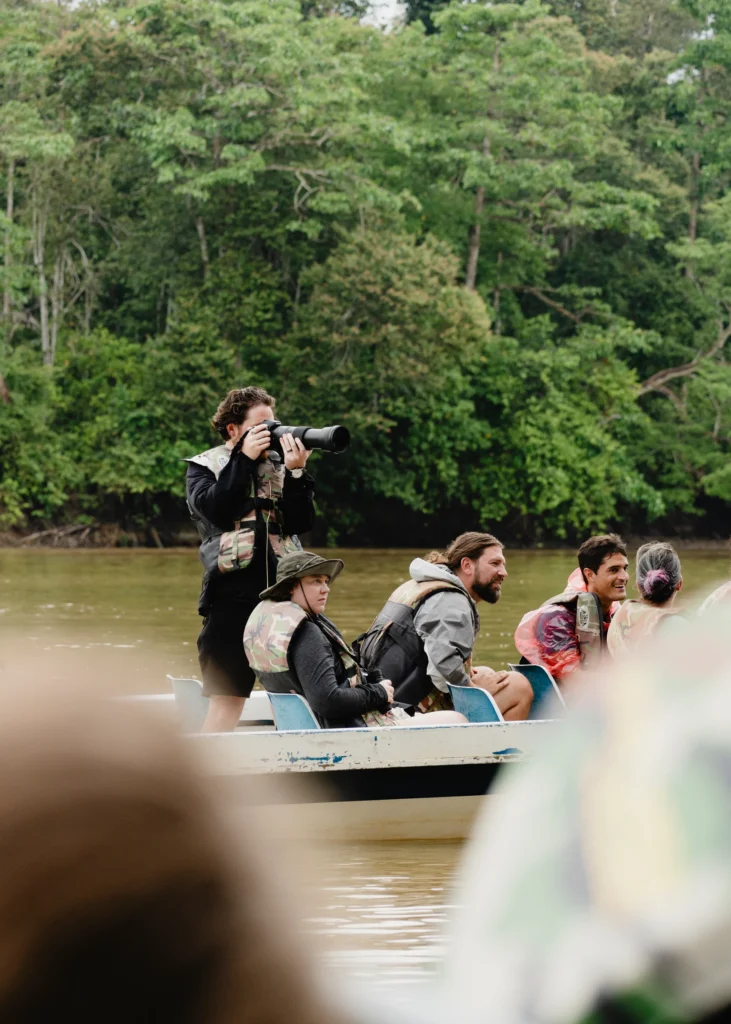
Low-impact cruises using quiet 4-stroke engines, reducing noise and fumes on the river
inverter air-conditioning units, energy-saving lightbulbs and ceiling fans in every chalet
Locally sourced menus focused on local produce, with an emphasis on vegetarian and vegan options
in the absence of sustainable local sources, we choose not to serve it
a maximum of 12 guests per boat and per activity, and fewer than 45 guests at the lodge
Sustainability at a jungle lodge should be visible, not filed away in a policy document. Most of what we have described here happens within walking distance of your chalet, and your guide will happily show you any of it.
You can see the elephant grasslands and walk the trails through our forest with a guide, in free rubber boots from the lodge. You can climb the three-storey wildlife observation tower, the only one in the area, and watch the canopy without a boat engine anywhere near you.
The rest is quieter: the compost heap behind the kitchen, the rainwater tanks, the refill station in the restaurant, the local produce in the buffet, the absence of bottled water in your room. Small things, done consistently, for as long as the lodge stands here.
Lower energy use in every chalet — please switch off when you head out.
Harvested rainwater for cleaning and gardening; refill stations instead of plastic.
Guides, boatmen and kitchen staff from Bilit and nearby villages.