Borneo has eight hornbill species and all eight occur along the Kinabatangan. You will not see all eight — almost nobody does in a single stay — but you will very likely see three or four, and knowing what separates them turns “a hornbill” into a specific bird with a specific story.
How to identify a hornbill in three seconds
Work through these in order:
- Size. Crow-sized, or eagle-sized? That single split removes half the list.
- The casque — (the structure on top of the bill). Big and curved upwards, flat and shelf-like, wrinkled, or barely there?
- Tail pattern. Hornbills are often seen overhead, and the tail is the clearest field mark from below: all white, white with a black band, or all dark.
- The sound. Several species are heard far more often than seen and their calls can be quite distinctive
The eight species
Rhinoceros hornbill
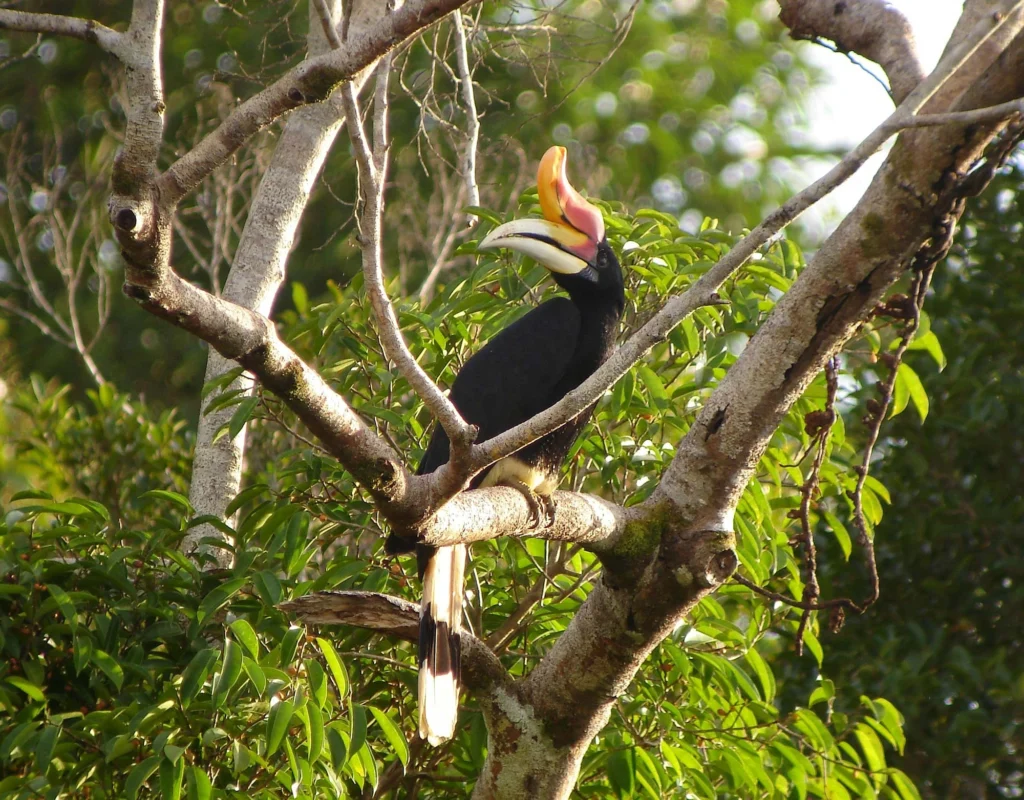
The one on our logo! Large, black-bodied, with a spectacular curved orange-red casque like a second bill. The tail is white with a broad black band across it. Pairs fly with a loud whooshing wingbeat you can hear from a distance — the air passing through gaps in the flight feathers.
Frequently seen along the river, often from the boat in the early morning
Oriental pied hornbill
The smallest and by far the most frequently seen. Black and white, with a modest pale yellow casque. Sociable, noisy, and comfortable around the forest edge, which means it turns up around the lodge, on the jetty trees and sometimes from your own balcony. Often in small parties rather than pairs.
This is the hornbill most guests photograph, simply because it sits still long enough.
Helmeted hornbill
The one you hope for and probably will not get. Large, with a solid casque — unique among hornbills — and extraordinarily long central tail feathers. The call is unmistakable and unforgettable: a long series of accelerating hoots that speeds up into what genuinely sounds like maniacal laughter, carrying for over a kilometre.
It is Critically Endangered. That solid casque is carved like ivory, and poaching pressure has driven the Helmeted hornbill’s numbers down. Hearing one is a real treat; seeing one even more so.
Black hornbill
Medium-sized and all dark, with a pale bill and casque. Some individuals have a broad white stripe over the eye and some do not, which confuses people. The tail has white tips. Quieter and more retiring than the pied, and often in dense riverside vegetation.
Bushy-crested hornbill
Dark, with a scruffy crest and a small low casque, and — usefully — the most social of the group. They move in noisy family parties of up to a dozen or more, calling constantly with a harsh, yelping, rather ugly cackle. If you hear a rowdy crowd of hornbills rather than a pair, this is your bird.
Wrinkled hornbill
Dark-bodied with a bright yellow or reddish bill and a low, ridged casque with the wrinkles that give it the name. Males and females differ noticeably in facial colour. It favours lowland and swamp forest, which the Kinabatangan has, but it is less numerous than the pied or rhinoceros.
White-crowned hornbill
The oddest-looking of the eight — a shaggy white crest that makes it look permanently startled, with a long white-tipped tail. Tends to move through the understorey in family groups rather than high overhead, which makes it a genuinely difficult bird to see well. A good sighting.
Great hornbill (rhinoceros hornbill’s larger cousin)
The largest of the lot, with a heavy yellow bill and a flat-topped casque like a shelf, and a bold black band across a white tail. In Borneo it is far scarcer and more localised than in mainland Asia. If you get one on the Kinabatangan you have had a good day.
The nesting behaviour that makes them worth caring about
Hornbill breeding is one of the strangest arrangements in the bird world. The female enters a natural tree cavity and then seals herself in, walling up the entrance with mud, droppings and food remains until only a narrow vertical slit is left.
She stays sealed inside for weeks — in the larger species, months — moulting her flight feathers while she incubates. The male feeds her and, later, the chicks through the slit, making trip after trip. If he is killed, the entire brood and the female usually die with him.
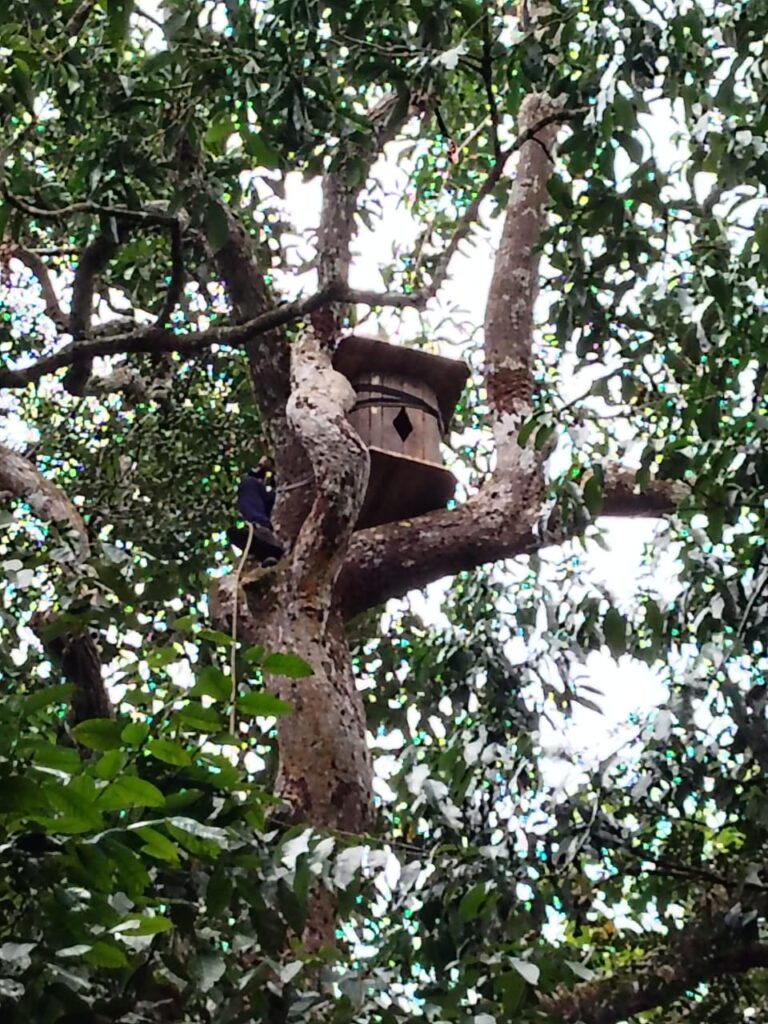
This has a direct consequence for conservation. Hornbills need large old trees with natural cavities, and those are exactly the trees that logging removes first. A forest can look green and hold no hornbills at all if it has no cavity trees left. It is why artificial nest boxes have been put up in several parts of the Kinabatangan, including at Hornbill Lodge.
When and where to look on the river
- Dawn cruise. Hornbills move between roost and feeding trees early, and that commute is when you see them flying across open river.
- Fruiting fig trees. A fig in fruit is a hornbill magnet, and our guides are always on the lookout for fruiting trees. Several species may feed in the same tree.
- Listen first. Rhinoceros wingbeats, bushy-crested cackling and the helmeted’s laugh all carry much further than the birds are visible.
Binoculars make hornbill identification far easier, if they will sit still for long enough. Keep yours to hand during river cruises.
We cover the rest of what lives along the river in our guide to Borneo’s Big Five, and the Kinabatangan page has more on the birdlife generally — around 300 species recorded, of which the hornbills are only the loudest.