Of all the animals people come to the Kinabatangan hoping to see, the proboscis monkey is the one they usually end up talking about at dinner. Orang-utans get the posters. Proboscis monkeys get the affection, because they are strange in a way photographs do not prepare you for.
They are also the most reliable sighting on the river. If you spend two nights with us and do the standard cruises, it would be highly unusual not to see them.
What a proboscis monkey actually is
Nasalis larvatus is found nowhere on Earth except Borneo, and within Borneo it is tied to water — mangrove, peat swamp and riverine forest. That restriction is why the lower Kinabatangan is one of the best places in Sabah to watch them: the habitat they need is precisely the strip of forest that survives along the banks.
The males are the ones on the postcards. A full-grown male can weigh over 20kg, twice the weight of a female, with a long pendulous nose that keeps growing throughout his life and a pot belly that is not fat at all. That belly holds a chambered, ruminant-like stomach full of bacteria which ferment the leaves and unripe fruit they eat. Ripe fruit is actually dangerous to them — the sugars ferment too fast in that gut.
Females are smaller, with a neat upturned nose, and are the ones you will usually see first because they move more.
Why the nose?
The honest answer is that biologists are still arguing about it, but the evidence points two ways at once. A bigger nose acts as a resonating chamber that makes a male’s honking call deeper and louder, and larger-nosed males appear to hold larger harems. So the nose is probably doing two jobs — advertising to females and warning off rival males — which is why it keeps growing rather than settling at an adult size.
How they live, and why it helps you find them
Proboscis monkeys live in two kinds of group, and knowing the difference makes the watching far more interesting:
- Harem groups — one dominant adult male, several females and their offspring. This is what you are most often looking at from the boat.
- Bachelor groups — younger and displaced males with no females, travelling together. Noisier, more restless, more likely to be chasing each other through the branches.
Both follow the same daily rhythm, and it is that rhythm — not luck — that makes them findable. They move inland into the forest to feed during the day, then come back towards the river in the late afternoon and choose a tree overhanging the water to sleep in. Sleeping over water is a predator strategy: a clouded leopard coming along a branch has nowhere to go, and if things get bad the monkeys can simply drop.
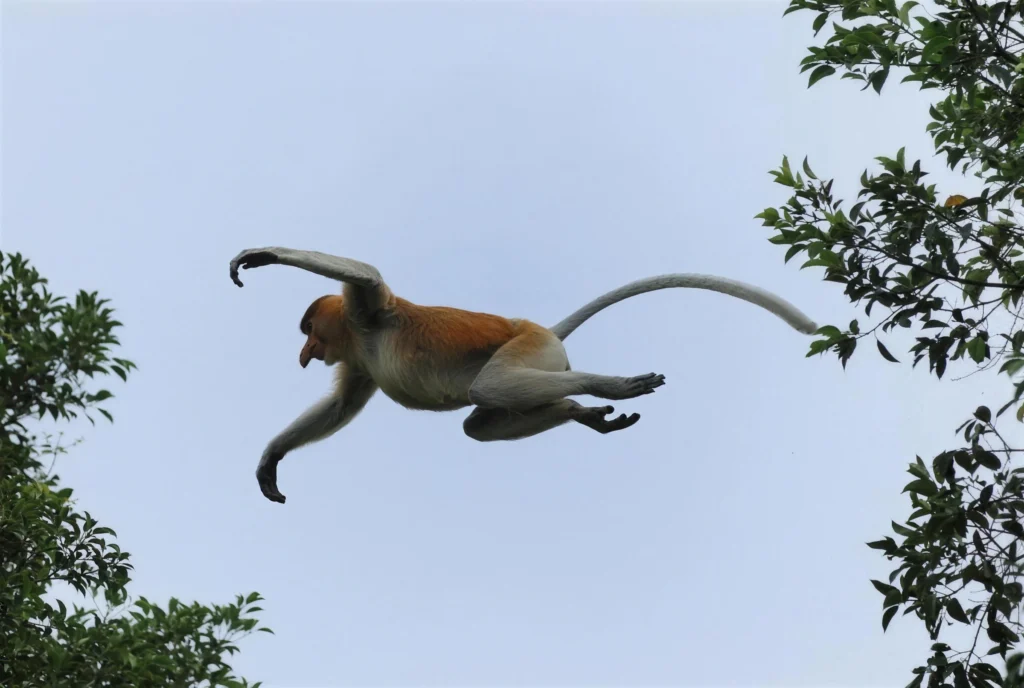
They are excellent swimmers, with partially webbed hands and feet, and will cross the river outright. If you are on the water at the right moment you may see a whole troop launch itself off a branch one by one — an unmistakable belly-flop, then a fast paddle for the far bank. It is the single best thing a river cruise can hand you.
When and where to look
The afternoon cruise is the one
Between roughly 4pm and dusk, troops gather at the water’s edge to pick their sleeping tree. They are settled, visible and unhurried, and the light is good.
Dawn is second best
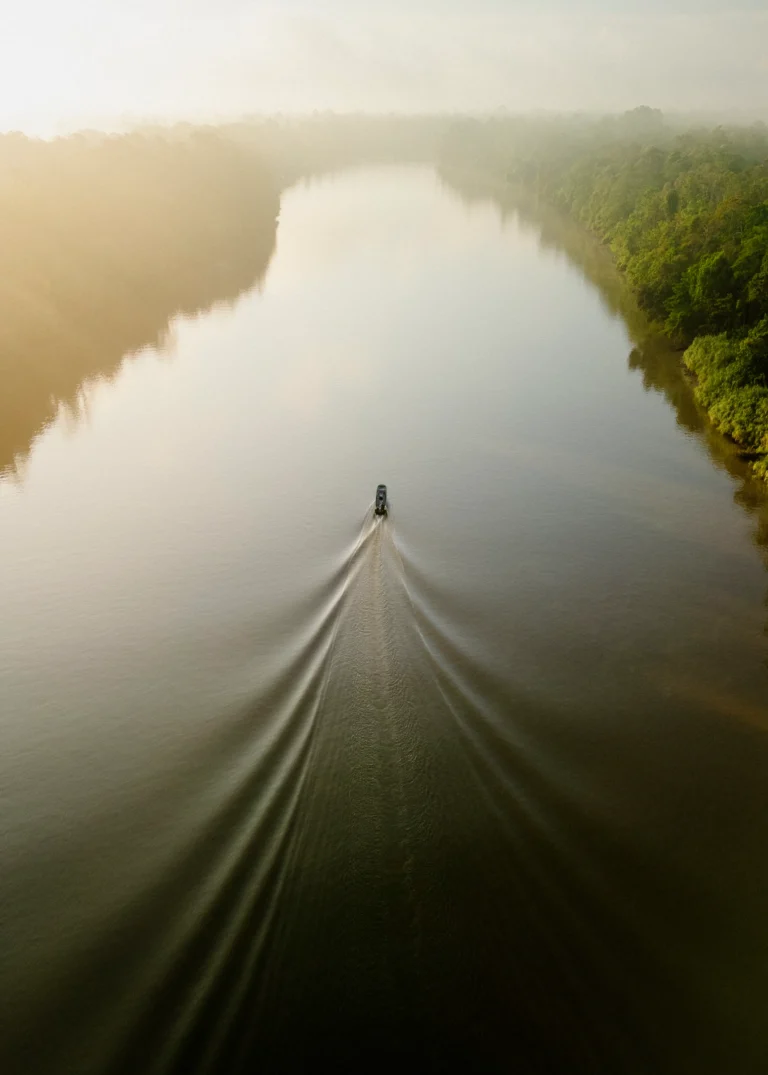
At first light they are still in the sleeping trees before dispersing inland. You get them silhouetted against a pale sky with mist coming off the river, which is a different and arguably better photograph, but a shorter window.
What to scan for
- Movement, not shapes. A branch that dips without wind usually means weight has just left it.
- The middle storey. They are rarely at the very top of the canopy and rarely on the ground. Look at the layer just above the water line.
- Pale bellies. The orange-grey back disappears into foliage; the light chest and belly catch the low sun and give them away.
- Listen. Honks, splashes and the crash of a big male moving carry a long way over water.
Are they endangered?
Yes. The IUCN lists the proboscis monkey as Endangered, and the pressure is habitat: the mangrove and riverine forest they depend on has been cleared extensively across Borneo for agriculture, aquaculture and settlement. What is left along the lower Kinabatangan is a fragmented corridor, which is why organisations and landowners along the river — ourselves included, across our 30 acres at Bilit — are trying to keep riverbank forest standing and reconnect the gaps.
Where else in Sabah
Outside the Kinabatangan, the Klias peninsula near Beaufort and the Garama river run proboscis-focused afternoon cruises within reach of Kota Kinabalu, and there are populations in the mangroves around Sandakan and Labuk Bay. Klias is the usual choice for people who cannot get to the east coast. If you are already coming to the Kinabatangan, you do not need to add it.
You can read about the other four animals people come here for in our guide to Borneo’s Big Five, see what the cruises involve on our activities pages, browse the 175-species bird checklist, or look at the two- to four-night packages that include them.